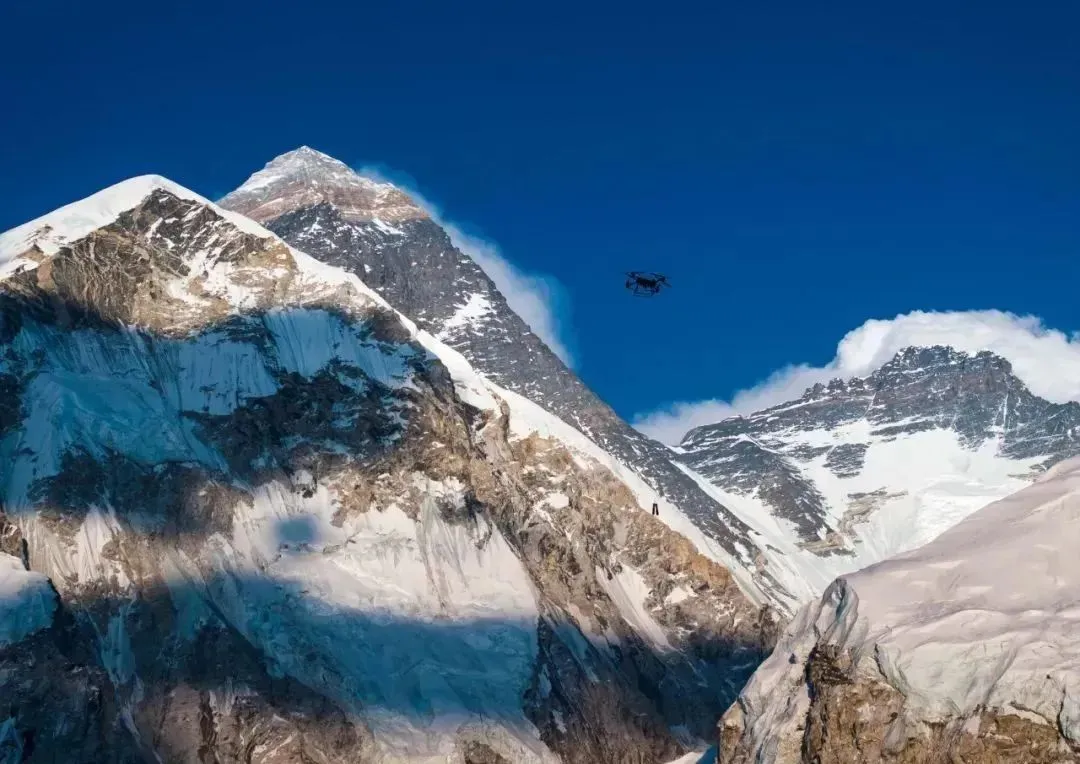

Nepal’s The Kathmandu Post reported on August 4th that this fall, Nepal will deploy heavy-duty drones to transport waste from Mount Ama Dablam, located south of Mount Everest at an altitude of 6,812 meters. This will mark the first commercial operation of unmanned aerial vehicles (UAVs) in Nepal’s high-altitude regions.
These heavy-duty drones, produced by Chinese drone manufacturer DJI, will take on tasks traditionally performed by Sherpas. Officials believe this will help reduce the number of casualties on Mount Everest.
On August 4th, the Sagarmatha Pollution Control Committee of Nepal, Khumbu Pasanglhamu Rural Municipality, and airmobility technology company signed a tripartite Memorandum of Understanding (MoU) to utilize advanced drone technology for effective waste management in the local mountainous regions.
In April of this year, DJI conducted the world’s first drone delivery test on Mount Everest. The results showed that their heavy-lift drones could transport supplies between Camp I and the South Base Camp. (People’s Daily: Chinese civil drones complete a test for material transport at an altitude of 6,000 meters on Mount Everest, with a stable load capacity of 15 kg.)
While U.S. lawmakers are pushing to ban Chinese drones, Nepali officials and climbers view these drones as life-saving tools. Traditionally, local Sherpa guides are responsible for transporting supplies and cleaning up waste on Mount Everest. They may have to cross the Khumbu Icefall more than 30 times in a season, carrying items such as oxygen cylinders, gas canisters, tents, food, and ropes.
Climbers and guides alike must navigate the notoriously dangerous Khumbu Icefall on their way to the world’s highest peak. As temperatures rise during the day, hanging glaciers melt, ice layers fracture, and the risk of avalanches increases. Even the most experienced Sherpas hesitate to cross the icefall under sunny conditions. Local Nepali official Bhusal said, “Using drones will help us avoid the dangers of the Khumbu Icefall.”
The Khumbu region has strict regulations on the weight of materials that can be transported. According to local government rules, personnel working in high-altitude areas can carry no more than 20 kg between 5,000 and 6,000 meters, 17 kg between 6,001 and 7,000 meters, 14 kg between 7,001 and 8,000 meters, and 12 kg above 8,000 meters. During the trial phase, the drones managed to carry up to 30 kg at Camp I, but this capacity decreased to 18 kg at Camp II.
Bhusal stated, “There are concerns that machines might reduce human jobs. However, our sole purpose is to reduce the potential death toll from crossing the Khumbu Icefall. We will train Sherpas, as drone operators cannot complete the tasks at higher camps. In the future, these jobs will be handled by Sherpas.”
In related news, DJI and People’s Daily previously reported that in April 2024, DJI’s transport team, equipped with the DJI FlyCart 30 (FC30), conducted a transport test in the southern region of Mount Everest in collaboration with 8KRAW and local Nepali partners. This marked the first round-trip transport test at altitudes between 5,300 meters and 6,000 meters, setting a record for the highest civilian drone transport. Following the successful test, a local Nepali drone operator initiated regular transport operations in the Everest region on May 22, focusing primarily on cleaning up residual waste on the southern slope of Mount Everest.
It is worth noting that DJI’s domestic partners are also promoting the application of the FC30 on other well-established commercial climbing routes, such as Mount Namcha Barwa and Gongga Snow Mountain.