

UAV (unmanned aerial vehicle) technology has advanced rapidly in recent years, as has UAV image transmission. The SwiftLink series of integrated video/data links by Airmobi exemplifies these innovations. This article provides an overview of developments in UAV video transmission since 2018, focusing on Airmobi’s Swiftlink P33 integrated video/data link.
I. Introduction to the Swiftlink P33 Integrated Video/Data Link
Swiftlink P33 is a TDD-based, two-way integrated video/data wireless transmission device independently developed by Airmobi. It features real-time interference detection, adaptive frequency selection, adaptive data rate, automatic retransmission, and automatic power control—enhancing resistance to multipath effects and interference. This design ensures high reliability, stability, and low latency.

Suitable for firefighting, inspection, monitoring, and more, Swiftlink P33 achieves up to 60 km+ transmission range under favorable line-of-sight (LOS) conditions.
Key Features
- Long-distance transmission: 60 km+ LOS at 4 Mbps.
- High-bandwidth transmission: 17 Mbps @ 10 MHz.
- Automatic relay support: Relay devices can join automatically.
- Multiple interface design: Dual Ethernet ports plus four serial ports (RS232, TTL, RS422, SBUS).
- Adaptive frequency selection: Automatically detects interference and selects optimal frequency.
- Automatic retransmission: Resends lost data packets for improved reliability.
- Adaptive data rate: Dynamically adjusts modulation.
- Automatic power control: Reduces transmit power at close range to save energy.
- Automatic antenna selection: Chooses the best antenna based on real-time obstructions.
- Dynamic uplink/downlink allocation: Automatically assigns bandwidth based on actual data flow.
- Multi-device co-existence: Up to six devices can operate on fixed frequencies simultaneously.
- Frequency matching function: Frequency pairing via software or hardware buttons.
Parameters:
- Working Frequency: 1350~1470MHz (2.4GHz and other frequencies can be customized)
- Wireless Channel: 2T2R
- Transmission Power: 33dBm (2W)
- Transmission Distance: Air-to-ground 30km+ (using omni antennas)
- Channel Bandwidth: 10MHz
- Modulation Mode: QPSK/16QAM
- Receiving Sensitivity: -99dBm@10MHz@QPSK1/3
- Data Rate: Up to 17Mbps@16QAM3/4
- Transmission Delay: 10ms
Interface Specifications:
- Radio Frequency Interface: SMA*2
- Equipment Interface: Network port *2 + TTL/RS232 *2 + 422 + SBUS
Electrical Specifications:
- Overall Power Consumption: Air Unit ≤ 25W, Ground Unit ≤ 10W
- Working Voltage: DC 9~26V, Typical value: 12V@3A
II. Recent Trends in UAV Video Transmission Technology
- Transition from single to composite links.
Single-function video links are uncommon now. Integrated systems combine video, data, and even control signals into a single link. - Move to standardized frequency bands.
Swiftlink P33 generally operates at 1.4 GHz, but 2.4 GHz, 5.8 GHz, and other bands are available upon request. - Higher transmit power.
Legacy UAV video transmitters often used 1W or 2W. Modern industrial-grade systems now range from 1W or 2W to 10W or 20W, covering 30–100 km or even 200 km. The Swiftlink P33 outputs 2W for distances beyond 30 km, while other SwiftLink models can reach 100 km+. - Relay functionality.
Swiftlink P33 supports automatic relay joining. - Shift from HDMI to Ethernet (ENET).
Swiftlink P33 features two Ethernet ports. - Evolving serial ports (RS232/TTL/RS422/SBUS).

Four serial ports are available:- Ports 1 & 2: RS232 or TTL
- Port 3: RS422
- Port 4: SBUS/TTL (configurable baud rate)
Two primary functions are supported:
- Serial-to-serial: Flexible mapping of local and remote ports.
- Serial-to-Ethernet/Ethernet-to-serial: Data can be input via serial and output via Ethernet, or vice versa, using TCP/UDP.
- Standard J30J connectors.
Swiftlink P33 uses a J30J-25pin connector. - Wide-range power input (DC 9–26V).
Compatible with 12V or 24V supply systems. - Refined design, minimal increase in size/weight.
Dimensions: 148 × 65 × 17 mm (+10 mm for SMA connectors); weight: 208 g. - Easier parameter configuration.
Web-based interface with default IPs for master (192.168.10.250), relay (192.168.10.251), and slave (192.168.10.252). A backup IP (192.192.192.192) is available if the default is forgotten (username: admin, password: 123456). - Practical additional features.
- LED for RSSI (also viewable via web).
- Distance display for range testing.
- Packet error rate (PER) display for packet loss diagnosis.
- Wireless Noise Detection for interference analysis around master and slave. Higher noise (e.g., -70 dBm) indicates stronger interference; relocating antennas or devices may help.
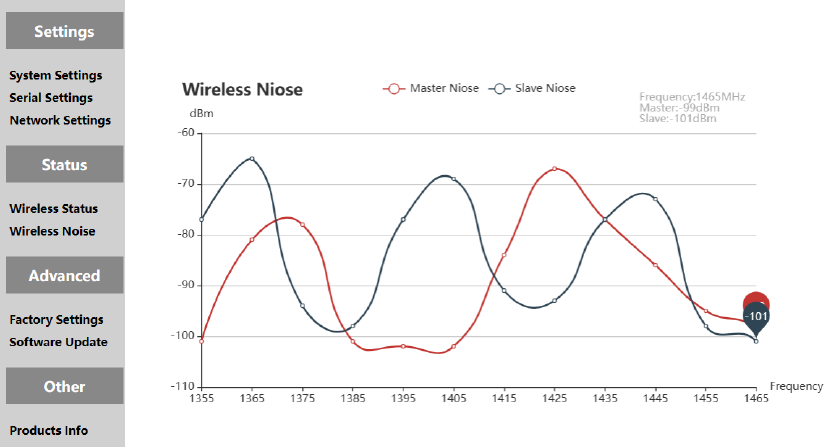
Swiftlink P33 Wireless Noise
III. Overview of the Swiftlink P33
Swiftlink P33 is a mid-to-high-end product with the following advantages:
- Wide operating temperature range (-40°C to 85°C): Maintains stable operation in extreme temperatures; tested for 72 hours at high/low temperatures.
- Advanced algorithms: Smooth, stable video transmission is maintained through retransmission mechanisms, antenna switching, and dynamic MCS adjustments, even at extreme distances of 4 Mbps or more. Multiple sets can run concurrently without interference.
- FPGA-based development: Frequency, power output, housing, interface, and more can be customized. This design provides strong scalability and flexibility at a competitive price.
IV. Usage Guidelines for the Swiftlink P33
To ensure stable and reliable performance, the following precautions are recommended:
- Use the correct power supply voltage.
A 12V/24V supply is recommended. - Install antennas before powering on.
Protects internal circuitry. Keep antennas at least 15 cm apart and away from large metal structures. - Maintain distance from other electronics.
Reduces noise and interference. - Optimize line-of-sight for range testing.
The ground antenna should be at least 3 meters above ground level. - Check connections and components before operation.
Ensure all cables are secure and components are functioning correctly.
By adhering to these guidelines and employing the capabilities of the Swiftlink P33, users can benefit from a high-performance, integrated video/data link solution suited to the demands of modern UAV applications.
